Blogs Through Writing 60
In this page you will find all of the blogs I have written from week 1 to week 10. Each blog consists of my twitter campaign and research progress trough the quarter. From my octopi intelligence research to octopi rights advocacy, this page will demonstrate how far I have come as a writer, researcher, and social advocate.
Transformative Learning
In my final days of Writing 60, there has been a lot to reflect upon. The different areas of growth in and outside of writing I have accomplished will influence my journey in academia moving forward.
Regarding my research skills, my approach to research has significantly changed. Prior to Writing 60, I went about research very systematically: I posed a question and plugged it into academic search engines such as Pubmed and Academic Search Complete. The concept of key words and truly putting intention behind the semantics of my search was not a process I had not been introduced to or thought had much of an impact on my research. However, this preconceived notion was proven wrong through my octopi intelligence research. Transforming my initial list of octopi, intelligence, brain to octopi, intelligence, cognition, observational learning, maze, vertical lobe, etc., I was able to expand the types of academic journals in my search results (primary experiments/review articles), broaden the scope of octopi research that would result from the search, and produce a well rounded review and advocacy project paper. This simple skill and step in the research process elevated the entire trajectory of my writing work this past quarter and I am excited to have this tool under my belt moving forward in academia.
Another transformative moment in my skills as a writer occurred in my communication with peers. From the initial groups we were assigned in class to complete the introductory activity, my peers and I have formed a group chat and improved communication with one another regarding our approach to each assignment and the writing pieces in general. The addition of peer review and these new found connections has lead to my communicative skills as a writer to improve. For instance, the language I use to describe writing has been elevated in situations such as conversations regarding improving topic sentences and how I approach assignments has broadened to incorporate beneficial perspectives of my peers. This has enabled me to go beyond the requirements of the course and each writing piece and produce wholistic works I am proud of. The refined language and articulation of writing pieces I have acquired through this course will benefit future networking and publishing endeavors in the future.
While Writing 60 has lead to a lot of triumphs, there were several problems I encountered to reach my current improved state as a writer. Timing was certainly an issue. While I accomplished all of the assignments well before they were due, I felt I spent too much time on assignments that should have taken no longer then an hour. This was most likely due to me doing each assignment at once instead of splitting up the portions of work over the course of a few days. Looking toward my next writing works, I will learned from this to curate a writing process that is more efficient over the span of a few days and evidently produce more refined work from the beginning instead of enduring a longer editing process.
I am definitely technologically challenged as well. Familiarizing myself with Wix as a proved to be a greater challenge than I would like to admit. I generally avoid attempting to use new technology as much as possible because I get easily frustrated and annoyed when I don't know how to change the color of a background or insert a picture correctly. After successfully understanding the different features of a basic website platform, I will adopt these skills in future employment and academic settings. To keep these skills sharp, I have recently started a passion project that is predominately online, and plan to create a website using Wix.

Week 10: Final Twitter Update

In the final weeks of Writing 60 and my Twitter campaign, I focused on spreading new information I have found in my advocacy project work. For example, I the process of how the Animal Welfare is amended and applied a similar process in forming my solution to add octopi. I also found a successful example of my proposed solution in the U.K. and tweeted about it to demonstrate to my audience that effective legislative change is feasible with the formation of a scientific panel in collaboration with the National Marine Coalition. Outside of my paper, I have used my final days of the campaign to learn more information about my peer's advocacy projects and the different species they researched. From shark social behavior to factory farming to deforestation due to the palm oil industry, my knowledge of the different mechanisms that can drive animals to extinction has expanded and has given me more motivation to continue my advocacy work in the future.
I am grateful for the platform Twitter has provided me over the last ten weeks. Prior to Writing 60, I had never used social media so heavily in an academic setting. I was always told that social media is not credible and to avoid using any knowledge posted when writing a review paper or research based paper. Reflecting back to my writing process, I now understand the benefit of using social media. While my primary sources should be scientific, social media offered me a great starting point for gathering initial general knowledge on octopi and ultimately guided my keywords list throughout the entire writing process. Going into future research settings, I will use social media to my advantage to culminate a full picture of information and present a well rounded project.
Week 9: Peer Review

In the past week I have completed a total of three peer reviews for the advocacy project paper. When I approach a paper, I apply a similar process. First, I do a general skim for headings or indicators that inform me of the topics covered and the overall structure of the paper. Then, I read the whole paper through and check that all of the content flows smoothly and correct any outstanding grammatical errors.
The first paper I reviewed was Liv Berger's, which was a report on cattle and the harm of factory farming. I got a good overall impression after reading this paper which can be accredited to the consistent professional tone and the thorough research presented. The main critique I gave Liv was about her topic sentences. During her literature review portion, the topic sentences still had the word choice and signal phrases of a review paper and not an argumentative piece. I suggested she replace those guiding sentences with the content of her argument against cattle farming to hint at the problem earlier. When she did pose her initial argument, I mentioned how she posed a question that called out that humans as a whole could be problematic in diminishing her argument. The question implied a general assumption that all people might not share in an accusatory tone, which could push people away from her argument if they disagree or are offended by the tone. I suggested she should assert that cattle farming is a problem and avoid presenting the problem as a question altogether to ensure the most effective argument.
The next paper I edited was Yuxiao Liang’s coverage of orangutans and the detriment deforestation is having on the species, pushing them to extinction. After reading this paper, I understood that the palm oil industry is a main contributor to habitat loss for orangutans, but that the argument could be presented in a more effective manner. In the introduction, she mentioned human spatial awareness and how it is crucial to our function, but never explicitly states orangutans posses equivalent abilities. With the rest of the literature reviewing relies on the fact that spatial awareness is carried out in orangutans and is crucial for their survival, I would add evidence to curate a clear introduction. Another general critique I gave throughout my review was to eliminate the abundance of questions weaved into the paper. In terms of constructing a convincing argument, presenting critical information such as the importance of orangutan spatial awareness and the problem of the palm oil industry as a question weakens the points she was trying to make and ultimately the effectiveness of inserting a question into the paper. I suggested she replace these questions such as “But outside these studies, in their living habitat, will the targets change into their food or home and the landmarks change into trees?” with assertions.
Peer review has been a process integrated into Writing 60 that I have found helpful. We began by commenting on discussion assignments in week one which progressed to full analyses of our final paper. A specific piece of advice I recall was from my peer Liv. She had mentioned a lack of urgency in regard to my problem of preserving octopi and taking them out of experimentation. To apply this comment to my paper, I strengthened my evidence to include more statistics to give the reader a better understanding of how many octopi are involved in experimentation and are being put at risk every day to create more urgency. Liv also mentioned I should allude to the problem earlier in my paper, which is definitely a valid critique I have been working towards implementing.
In writing, I have felt the great benefits of peer review. Receiving alternate perspectives on my writing has helped me improve my focus and organization. Honestly, I think the worksheets offered during peer review could have diminished the peer review process. I received a lot of general “everything looks good” for the sake of filling out the form instead of constructive advice which could have been achieved through someone directly commenting on my paper. Constantly reading others work made me more aware of my topic sentences the most. I gave the most feedback on my peer’s topic sentences which caused me to reflect on my own. Outside of writing, peer review helped me form better relationships with my peers and build connections at school I would not have before.

Week 7 Reflection
Starting the social media campaign has certainly broadened the scope of my research and the current solution to the problem of the lack of rights octopus have in research labs and the growing threat of octopus farming. So far, I have been focused on the negative impacts octopus farming will have on the species of octopus themselves, but twitter has helped me understand the effects aquaculture has on the surrounding environment. Aquaculture produces tons of toxic waste diffused into the surrounding along with requiring thousands of tons of food needed sustain the species taken from natural marine life. Farming animals is fundamentally unsustainable, which is ironic because the whole point of farming is to make the farmed species more sustainable. Additionally, I have gained access to a lot of helpful petitions and advocacy websites, such as @AnimalJustice. So far, my best tweets a call to action, whether that be toward legislation or a petition, and included an emotional image. Throughout my twitter campaign, I have applied tactics we have explored in argumentative writing to gather a wider audience and more support. For example, I have built credibility by introducing accomplished researchers and famous studies and evoked emotion through visceral images for an emotional appeal. Going into the argumentative essay, my main focus will be to help the reader see how octopus farming and medical labs are harming the wonderful intelligence that I introduced in the literature review. I will incorporate clear topic sentence that effectively construct my argument against these issues. Of course, I will add emotion by building the idea that octopus are more like humans that initially perceived, so the audience can have a greater connection and care about the issue. My infographic displays the increased use of octopus for federally funded research since the 1990s. I created this infographic to show how more and more octopi are used medical labs without any protection against unethical treatment, creating a sense of urgency to the issue.

Week 4 Reflection
Twitter has become a critical tool over the last few weeks to expand my awareness on current cotopi intelligence research and how the development of their inclusion in the Animal Welfare Bill is still a prevalent issue. Aside from research, Twitter has also enabled me to visualize the species and learn about other species from the common Octopus Vulgaris. For example, just a week ago @gunsnrosesgirl3 posted a video of an octopus seeing a predator and instantly settling on the sand and camouflaging in a matter of seconds. Additionally, I have been able to explore both the Dumbo Octopus how their blue blood is a crucial adaptation the species has acquired to adapt to harsh marine life.
While Twitter has guided me in learning about octopus, reading my fellow classmates blog posts have been helpful in learning about the writing/research process. Liv is researching cow intelligence and cognition and I was able to check myself on ensuring my paper is clear and no medical jargon I use loses the reader. Parker also aided me in checking my focus, as he is researching coyote social behavior, which involves dogs so it is important he focus on coyotes and not get lost in dog sociability.

Week 3 Reflection:
After this week, I am confident that my research topic will be centered around octopus intelligence and the specific mechanisms behind their high cognitive function. So far, I have found that octopus possess analogous brain structure and function to humans, yet are often underestimated. Most research that has illustrated a level of intellect in octopus has been done on Octopus vulgaris in the early 2000s. Common tests of intelligence have included mirror tests, learning from observation, and following an octopus's neurotransmitter activity to deduce brain function. Since last week, the trajectory of my research has specified to focus on Octopi vulgaris and review the immense level of consciousness they possess through past primary experiments. I want to dive deeper in the brain structure of octopi and how it is comparative to ours. For example, octopi have a vertical lobe that preforms the same function as a human hippocampus in terms of memory formation and storage. In narrowing down my topic, my research processes consisted of narrowing down my list of key words and finding review articles that lead me to strong primary research. The most helpful keywords thus far have been octopus vulgaris, cognition, learning, memory, neurobiology, and brain function.I have also learned about some influential researchers in the field, such as Binyamin Hochner, who specializes in motor control of the flexible arms of the octopus and is currently working at The Alexander Silberman Institute of Life Science. The best resources for finding out the basics of octopus intelligence have been google scholar, Pubmed, Academic Search Complete, and news sources such as Scientific American and The Guardian. Concluding this weeks research, the best source I found thus far is "Observational learning in Octopus vulgaris," by Fiorito G., and P. Scotto. The source presented a straightforward experiment that not only provided useful background information on octopus brain function, but demonstrated how octopi can learn through watching others around them. I look forward to progressing this research in the up coming weeks.

Figure From Fiorito and Scotto paper depicting how the right octopus is attacking the correct colored ball, a learned behavior in the experiment.
Week 3: Exploring Research Demonstrating Octopi Intelligence
Fiorito, G., and P. Scotto. 1992. Observational learning in Octopus vulgaris. Science 256: 545–547
Finding this article took a lot of shifting through key words and using review articles to find original research they discussed. Using the key words cephalopod and neurobiology I was able to find the article, “The Octopus: A Model for a Comparative Analysis of the Evolution of Learning and Memory Mechanism.” From there, I skimmed through the article for points regarding experiments that proved octopi cognitive ability and went to the works cited section to obtain the original research pdf. Fiorito and Scotto proved that Octopus vulgaris can be trained through observation, which demonstrates high brain function. They tested this theory in three phases with the main methods of observation and operant conditioning (shock vs small piece of fish): training of demonstrator octopi, observation of the task by untrained octopi, and testing observers behavior. The trained group was tasked with attacking either a red or white ball, with the red ball being the “right choice,” as those who chose the red ball were rewarded with a small piece of fish and shocked electrically if the white ball was chosen. Training was complete when the octopi made no mistakes within five trials. After training was complete, the observational phase included those octopi who were in a tank next to the demonstrator octopi. After 5 days, the untrained octopi had little to no error in choosing the red ball, supporting the conclusion that observational learning occurs in Octopus vulgaris which is a reflection of their highly developed brain. This study helped us understand how octopi behave and learn is comparable to vertebrate animals process new information. After this study, it is intended that the reader reflect on how this high cognitive function is displayed in their natural environment.
Hochner Binyamin, et al. “A Learning and Memory Area in the Octopus Brain Manifests a Vertebrate-like Long-Term Potentiation.” Journal of Neurophysiology, vol. 90, no. 5, Nov. 2003, pp. 3547–54. EBSCOhost, https://doi.org/10.1152/jn.00645.2003
Applying the same method as before, I used the article “The Octopus: A Model for a Comparative Analysis of the Evolution of Learning and Memory Mechanism,” to gather primary research articles that addressed octopus intelligence through experimentation. I also applied the new key words “learning” and “memory” to find “A Learning and Memory Area in the Octopus Brain Manifests a Vertebrate-Like Long-Term Potentiation,” by Binyamin Hochner, Euan R. Brown, Marina Langella, Tal Shomrat, and Graziano Fiorito. The paper consists of a comparative analysis of invertebrate brain mechanisms, specifically Octopus vulgaris. To test the highly developed vertical lobe (VL) (contributes to learning and long term memory formation) of octopi, the experimentation involved anesthesia of octopi, treating the vertical lobe to track administered electric shocks, and analysis of the amplitude which reflects octopi response to various stimuli. It was concluded that stimulating the MSF evoked a large potential that derived from postsynaptic neuron activity and varying intensity thresholds of nerve activity demonstrated octopi are capable of cooperating and forming long term memory. The slicing of the VL revealed the structure to be analogous to our hippocampus and illustrated basic plasticity principles. A glutamatergic mechanism comparable to serotonin was also found active, serving as a function of the associative learning network in the Octopi VL. Reflecting upon the study, it made a great contribution to helping us comprehend the specific mechanisms that contribute to how Octopi learn, the evolution of the VL and how it was a selected, conserved area critical for facilitating cognitive behavior, and how Octopi vulgaris are more similar to our brain function than initially assumed.
Take Away:
Overall through this assignment, I have been able to effectively find primary and secondary research articles for any topic. I have learned that starting is the least important part, and some of the first papers I come across will likely not be used in my literature review, but to narrow down my keyword list or help me find specific research through their works cited. Also, when approaching a scientific paper, it was helpful to read the conclusion first, that way I understood the main objective of the lab and was able to interpret the data correctly while reading.

Week 3: Invested In Twitter
The twitter space has enriched my passion for animal advocacy on a national scale and broadened my scope of endangered species I want to help. For example, I had no idea over 260 million male chicks were discarded on some sort of conveyer belt each year because they don't reproduce or that hippos are on the verge of going extinct because of trophy hunting and poaching. I also became aware of more ways in which octopi are treating unfairly in medical settings, as I retweeted Barbra King's post regarding how octopi and squids' arms are amputated during nerve sensory research. Some of the most interesting accounts I followed included @MercyForAnimals, @carlzimmer, @Network4Animals, and @yggdrasil13751 (Professor at UC Davis studying microbiology, genetics, and genealogy) . The best tweets in my opinion included an image or video to appeal to the emotions of the reader and cause them to click on the article.
In Addition to Twitter, I have gotten a chance to read my classmates blogs and further expand on my knowledge of animal cruelty and also compare how my classmates interpreted the TIMEs articles. When I read Emily's blog, I discovered we are both interested in changing the narrative in referring to animals as "who" rather than "it" to promote animal equality. Khalia and I are both new to the twitter space and have used the platform to learn about species outside our chosen research area, for example she is researching coyotes but has learned about various types of hunting in the US. Finally, Haley and I both have dogs and had a similar response to the TIMES article about communication: we both question how much our dog understands us and just how we are annoyed when they bark, what is their interpretation of us yelling? Overall great conversation starters and excited to read more as the quarter progresses.

Animals Are Often More Capable Than We Think: Reflection of TIMES Articles and Summary of Into the Mind Field Prologue
Having a dog for the majority of my teen years, I have always had a warm spot for animals. After reading the TIMES series addressing animal emotion, intelligence, and communication, my perception hasn't substantially changed in the traditional sense.What I mean by this is that I have honestly always perceived animals as capable of feeling emotion and never considered the alternative perspective to be the most common. Throughout each article was an undertone that most scientists and people are hesitant to acknowledge the true capabilities and capacity animals maintain. Within the article, “Animals talk, even if we can’t understand them,” the quote “just as we look at animals in confusion or indifference as they emit their strange barks, yelps, squeaks, and chirps, so they look at us,” embodies how the unfamiliar scares us as humans and how we never consider what that the animal might be just as confused as us.
Simply because animals might use vibrations or barks as means of communication or carry their dead when grieving does not make the experience any less valid or human for that matter. If anything, reading these articles has only made me more curious about the neuroscience behind animal behavior and how despite several differences in brain structure, animals and humans continue to carry out similar functions.
The Prologue of Into the Mind Field by Safina confirms the “forbidden” question underlying all of the TIMES articles of how humans avoid asking why animals behave the way they do. She mentions how this barrier is put up relatively unconsciously by referring to animals as “it” instead of “who.” Confirming that animals know who they are and have complex alliances, rivalries, and rank in their social structures, Safina introduces the reader to the wide capabilities animals possess. The prologue also makes an important point often overlooked: we are animals so this lack of intimacy is somewhat silly. I look forward to learning more about the mechanisms behind animal behavior and listening to their stories.


Week 2: Entering the Twitter Space As An Activist
This week I took my message into the twitter space and found the experience quite rewarding. Navigating the app has been extremely easy, which has helped me in my advocacy for octopus rights. Moving forward, I plan to focus the platform on how octopi are treated in medical labs and their potential for being named sentient animals in farms. I followed accounts such as @saveourseas and @science_octopus to help broaden my knowledge on octopi and gain powerful insight on the current happenings on the issue. For example, I retweeted @ciwf's (compassion in world farming) tweeted regarding their article that outlines the cruel plan of octopi farming, mentioning that 1 in 5 octopuses would not survive the entire production cycle confined along with a petition. I also retweeted @Leosanimalplanet1's tweet to spread the word of Pescanova's octopus farm plan for this upcoming year. Despite having my account up for less than a day, I have already gathered a good amount of followers, proving the space a promising platform.
Week 1: Octopi and I Getting Acquainted:
Week one complete! Simply a matter of counting down to week ten from here. Entering Writing 60, I hope to build upon my argumentation skills and develop a more concise writing style. In high school, my writing experience and style derives from a wide range of experience. From a more formal academic setting of courses like AP Literature and Composition and AP Language and Composition to composing and publishing an independent research project to journaling daily, my writing style presents itself as both conversational and formal. While I found more enjoyment in AP Literature because I am a bit of a book nerd, the research portion of AP Language interests me. My reading skills in an academic setting have definitely been refined in the past year. I have not only understood how to approach common works of literature such as magazine articles, but more complex styles like scientific review articles. I have had some experience in the research field while researching, writing, and publishing my original review paper on human stem cell potential to ameliorate penetrating traumatic brain injury. Going through that process over the course of four months certainly strengthened my reading skills along with my formal academic courses. In regards to my writing skills, I would argue that I am a pretty strong writer. I excel in the creative and thoroughness aspects of writing as I often find myself cutting down my work rather than trying to fill a page. Despite my organization often being weak due to my natural scatterbrain, I have put forth a lot of effort over the years to polish my writing structure. The same goes for my sentence structure, as I often fall victim to run on sentences. My writing process almost always involves beginning with a string of google searches guided by a general idea or rough thesis. I then organize each source by their purpose and topic in a chart. After I have a good variation of sources, I adjust my thesis accordingly. The general organization of my writing places the strongest evidence at the end and supporting topics following the introduction. Another part of my process is to include a paragraph after the introduction that defines key terms or ideas that the audience might not be familiar with to curate greater comprehension from the reader.
The Times article “Animals have brains, but do they have minds” mentioned two topics that are of great interest to me: how different animals possess different brain structures yet conduct similar functions and how primates demonstrate similar behavior to humans. According to the article, the cerebral cortex is where creativity lives, which plays an integral role in whether animals use tools and how they do so. Birds, however, are one of the best tools at manipulating their environment into useful tools, as crows bend wire to create a hook for retrieving food. This topic fascinates me because in my future research I want to learn more about how different parts of the brain function across species, which can help me develop better treatments for when said parts are damaged. The article also describes the theory of mind, where one realizes not all knowledge is universal. While toddlers experience this theory at age 3, it is rare in animals. Toward the end of the article, it mentioned how animals kept in captivity and raised similar to humans, like Kanzi, might have these abilities but their natural environment does not demand their expression. I am curious to find out more about what functions in our brains can be “unlocked” by changing out environment.
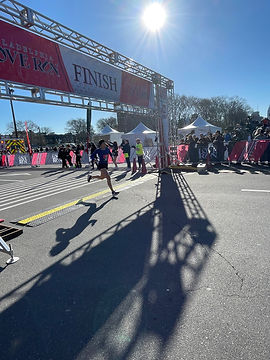
Me completing the Philadelphia Half Marathon over spring break.